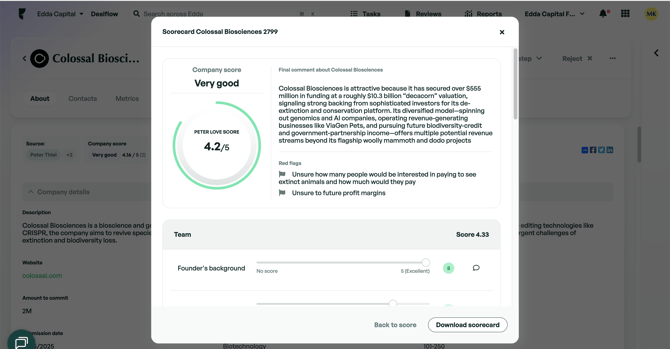
By standardizing how startups are assessed, across stage, sector, and team members, scorecards enable objective decision-making, highlight alignment or divergence, and surface insights that improve investment outcomes and pipeline health.
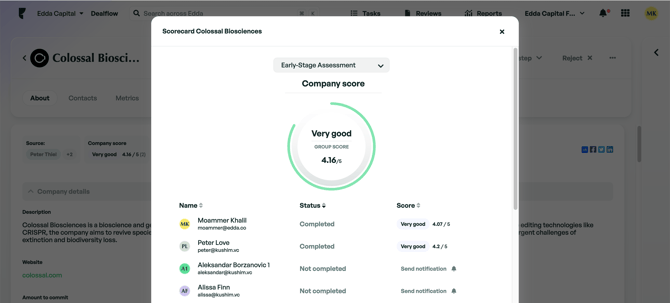
1. Collaborative deal evaluation
- Purpose: Bring structure and transparency to deal discussions by having all team members independently score and comment.
- Example: Each partner scores a potential Series A deal separately. During the Monday meeting, the team reviews all scores, comments, and red flags side by side, seeing where opinions align or diverge.
2. Customisable evaluation frameworks
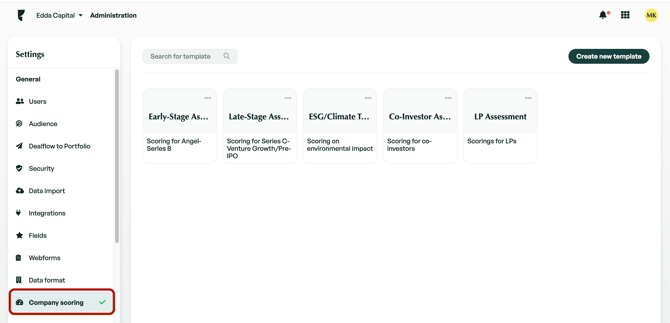
- Purpose: Build tailored templates for different stages, sectors, or strategic focuses.
- Example: A VC creates two templates, one for early-stage (emphasizing founders and product) and one for growth-stage (focused on market size and financials).
3. Weighted scoring & decision-making
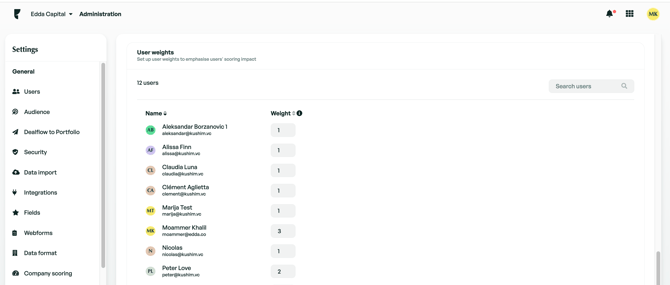
- Purpose: Reflect firm priorities and decision influence by assigning weights to sections and users.
- Example: A partner’s score carries more weight than an analyst’s, and product evaluation counts more heavily than team or GTM for p.e. deep-tech deals.
4. Deal comparison & Portfolio insights
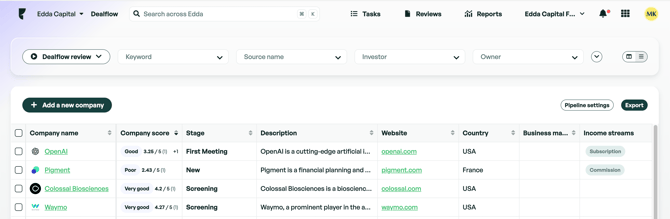
- Purpose: Identify scoring trends and improve decision quality over time.
- Example: The team reviews all Q3 deal scores and sees a consistent undervaluation of go-to-market strength. They adjust future criteria accordingly.
5. Partner meeting preparation
- Purpose: Prepare structured, data-backed discussion materials for partner or IC meetings.
- Example: Before the Investment Committee, the team exports a summary with weighted scores, comments, and red flags, providing an instant overview of alignment and concerns.
Metrics
The product team should define success metrics for launch (e.g., adoption, engagement).
The above will also be used to measure the success of these initiatives.
Next steps
- Finalize and schedule launch announcement (email + in‑app).
- Schedule the five use case emails above (weekly or bi‑weekly cadence TBD).
- Post‑launch: track adoption & gather client success stories if possible.
- Analyze results internally, and validate the project or adapt it if needed.